When Language Hides the Actor: Why Grammatical Agency Matters in AI Output
- Agustin V. Startari

- 16 hours ago
- 2 min read
Why agency is a linguistic problem
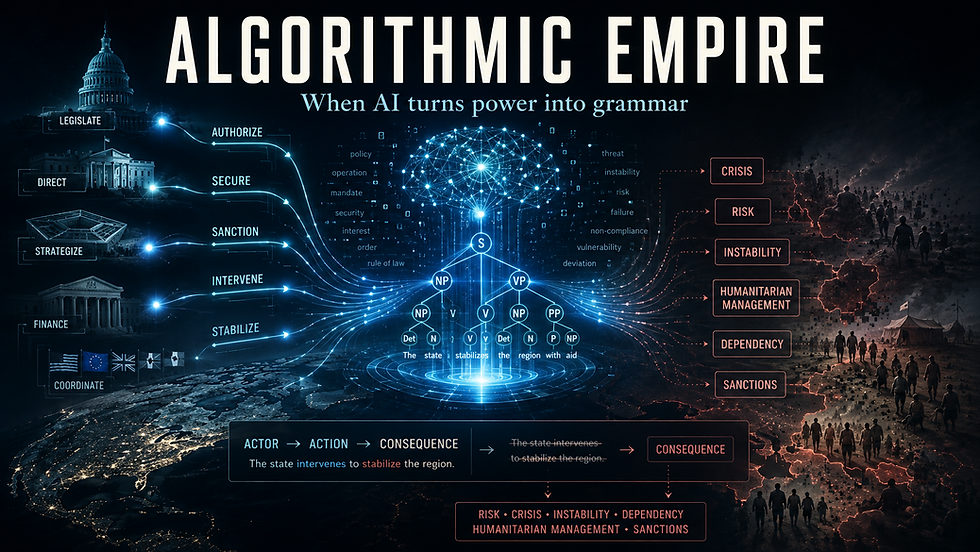
A sentence does more than report an event. It distributes attention. It can name who acted, foreground who suffered, or remove the actor entirely. In human writing, these choices are often rhetorical. In AI-generated language, they can also become systematic patterns produced at scale.
The difference between describing and assigning responsibility
Compare a formulation that identifies an actor with one that presents an event as if it simply occurred. Both may be grammatically correct, but they do not carry the same causal architecture. One preserves a chain between action and agent; the other can weaken it. That difference becomes politically significant when language concerns war, institutions, sanctions, policing, or other forms of organized power.
Why AI output deserves linguistic scrutiny
Generative systems do not merely retrieve facts. They assemble sentences, choose subjects, select verbs, and decide what can remain implicit. Those decisions shape how readers encounter causality and legitimacy. Evaluating AI therefore requires more than checking whether a statement is factually accurate. We also need to ask how its grammar distributes visibility and responsibility.
A practical test
When reading an AI-generated political statement, ask four questions: Who appears as the grammatical subject? Who performs the consequential action? Who is described primarily through effects rather than agency? What causal relation disappears if the sentence is rewritten in the active voice? These questions do not settle interpretation, but they reveal where syntax may be doing political work.
Language is part of the system
The important point is not that every passive construction is deceptive. It is that repeated grammatical choices can create patterned asymmetries. If certain actors are consistently represented as decision-makers while others appear mainly as crises, risks, victims, or objects of management, the linguistic pattern itself becomes an object of analysis.


Comments